If you’re an internationally qualified physiotherapist planning to practise in Australia, 2027 brings an important opportunity.
The Australian Physiotherapy Council (APC) has announced six Written Assessment sittings in 2027, compared with four previously. With examinations scheduled approximately every two months, candidates now have greater flexibility to plan their preparation.
But more exam dates do not automatically mean better exam outcomes.
As clinical educators, we emphasise that preparing for an Australian clinical assessment requires more than revising textbooks or completing hundreds of multiple-choice questions.
It requires understanding how to apply clinical knowledge, prioritise patient safety, interpret unfamiliar presentations and make decisions consistent with Australian physiotherapy practice.
In this guide, we’ll explain what has changed, how to prepare effectively, and how to build a structured pathway through both the Written and Capability Assessments.
What’s changing in the APC Written Assessment in 2027?
The APC has published the following Written Assessment schedule for 2027.
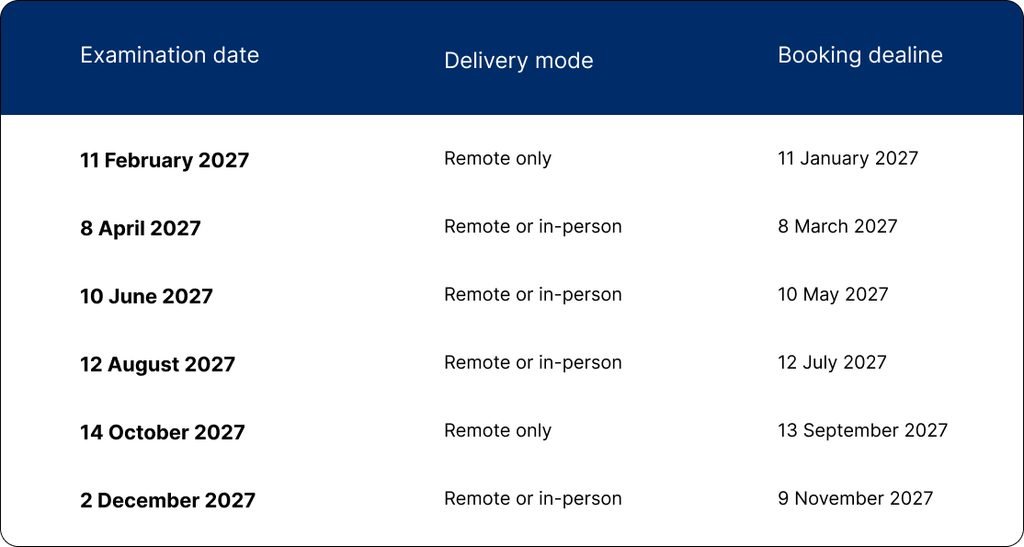
This expanded schedule gives you more flexibility to choose a sitting that aligns with your preparation and personal circumstances.
The key question is no longer simply, “When can I sit the examination?” It is, “How can I prepare effectively for the examination I choose?”
What knowledgeable physiotherapists struggle with?
One of the challenges for internationally qualified physiotherapists is adjusting from recalling clinical knowledge to applying it within unfamiliar clinical scenarios.
For Example:
Consider a patient presenting with low back pain. You might understand the relevant anatomy, pathophysiology, assessment procedures and treatment options.
But what happens when the case includes possible neurological involvement, psychosocial factors, or signs that warrant urgent medical assessment?
You may need to determine:
Which clinical finding is most important?
What additional information would influence your decision?
Is physiotherapy management appropriate at this stage?
When should you refer or escalate care?
Which option is the safest and most clinically appropriate?
These questions test clinical reasoning rather than memorisation alone.
This is why we encourage candidates to focus on how they arrive at a clinical decision, not simply whether they selected the correct answer.
At Physiomates, this principle informs our approach to clinical education and examination preparation.
Understanding the APC Written Assessment format
According to the Written Assessment Information Booklet, the assessment consists of the following:
- 2 Exams paper
- 60 MCQs per paper
- 120 Minutes per paper
Each paper contains 15 clinical cases. This means candidates need to develop the ability to interpret patient information & apply clinical knowledge under time constraints.
Your preparation should include musculoskeletal, neurological and cardiorespiratory physiotherapy, alongside clinical decision-making, patient safety and professional reasoning.
Rather than spending all your study time passively watching lectures, you should regularly practise unfamiliar cases and analyse your reasoning.
That is where structured question practice becomes valuable.
How to tell whether you’re actually ready for the Written Assessment?
Many candidates measure preparation by how much content they’ve completed.
“I’ve finished musculoskeletal physiotherapy.”
“I’ve revised neurology.”
“I’ve watched all my lectures.”
But completing content and being able to apply it independently are two different things.
A more useful approach is to monitor your performance across unfamiliar clinical scenarios.
Ask yourself whether:
You can identify important clinical information
Select a defensible management priority
Explain why other options are less appropriate
Make decisions within the allocated time.
Practise with Physioprep AI
Developed as part of the Physiomates learning ecosystem, Physioprep AI helps candidates practise APC-style clinical questions and monitor their progress throughout preparation.
Features include case-based questions, mock assessments, AI-powered explanations, adaptive practice and a 0–100 readiness score.
Rather than repeatedly practising only the topics you already understand, you can use your performance patterns to identify areas requiring further attention.
The readiness score is a learning indicator, not an official APC prediction or guarantee of passing.
You can explore Physioprep AI with a 14-day free trial.
Start your 14-day Physioprep AI trial
A practical 12-week APC Written Assessment preparation plan
A structured preparation plan can make the difference between studying consistently and feeling overwhelmed by the volume of material.
Here’s an example of how candidates can organise 12 weeks of focused preparation.
Weeks 1 and 2: Establish Clinical Baseline
Review the assessment requirements, identify your stronger and weaker clinical areas, and complete an initial set of mixed clinical questions.
Weeks 3 to 7: Build and apply clinical knowledge
Work systematically through musculoskeletal, neurological and cardiorespiratory presentations. Combine topic revision with clinical scenarios and explanation-based learning.
Weeks 8 to 10: Develop examination decision-making
Introduce mixed-topic practice, timed questions and deeper analysis of incorrect answers. Focus on identifying clinical priorities efficiently. Mix topics and add timed practice. Review why an option is the best answer for that particular patient.
Weeks 11 and 12: Consolidate and assess readiness
Complete full-length timed practice, review recurring errors, confirm examination requirements and prepare your exam-day routine.
There is another important consideration here!
Your Australian physiotherapy journey does not necessarily end when you pass the Written Assessment.
For candidates following the relevant APC assessment pathway, the APC Capability Assessment is another significant stage of preparation.
Preparing for the APC Capability Assessment
Passing the Written Assessment is an important milestone, but it is not the final stage for candidates completing the Australian Physiotherapy Entry Pathway (APEP).
The Capability Assessment evaluates how candidates demonstrate clinical reasoning and professional decision-making through an oral assessment format.
It requires you to communicate your reasoning, not simply recognise the correct option from a list.
For Example: You may need to explain your assessment priorities, justify your management approach, recognise patient safety considerations and communicate your decisions clearly.
These are skills that develop through deliberate practice, discussion and feedback.
This is why we believe Written and Capability Assessment preparation should be connected, rather than treated as two completely separate learning experiences.
Introducing PACE Global: One structured preparation pathway for both assessments
PACE Global is our comprehensive preparation programme for internationally qualified physiotherapists working towards the APC Written and Capability Assessments.
It brings together structured clinical education, case-based learning, examination preparation and educator-led mentoring.
COMPLETE PROGRAMME FEE
AUD $3,500
Upfront payment option for the combined Written and Capability preparation programme.
Start with AUD $200
Reserve your enrollment and begin accessing your initial learning modules with a registration payment credited towards the total programme fee.
Approximately ₹13,999 INR as an indicative amount.
Explore PACE Global at Physiomates
Why prepare for both assessments together?
Clinical reasoning is not a skill you need only for the Capability Assessment.
It is central to how you interpret and respond to clinical cases in the Written Assessment as well.
When your preparation connects both stages, you have an opportunity to progressively build on the same clinical foundations.
For candidates who want a guided learning pathway rather than organising multiple separate preparation programmes, PACE Global provides a coordinated approach.
The goal is not simply to help you answer examination questions. It is to support the development of clinical reasoning that remains valuable in Australian physiotherapy practice.
Not ready to enrol in a full programme? Start with 14 days of practice.
You may still be exploring your options, comparing preparation methods or deciding which examination sitting is realistic.
You don’t have to make a full programme commitment to begin learning. Start free prep trial for 14 days.
Physioprep AI provides a practical starting point for candidates who want to experience case-based practice and identify their learning needs.
During your 14-day free trial, consider the following approach:
Days 1–3: Complete an initial set of mixed clinical questions to identify your starting point.
Days 4–7: Review your weaker topics and examine the explanations behind incorrect responses.
Days 8–11: Practise new clinical scenarios and focus on your decision-making process.
Days 12–14: Review your performance patterns, timing and areas requiring further development.
At the end of two weeks, you should have a clearer picture of how structured practice fits into your preparation routine.
Explore Physioprep AI and start your free trial